Who Is Andy Burnham? Everything to Know About the UK’s New Prime Minister
Published
Categorized as Politics
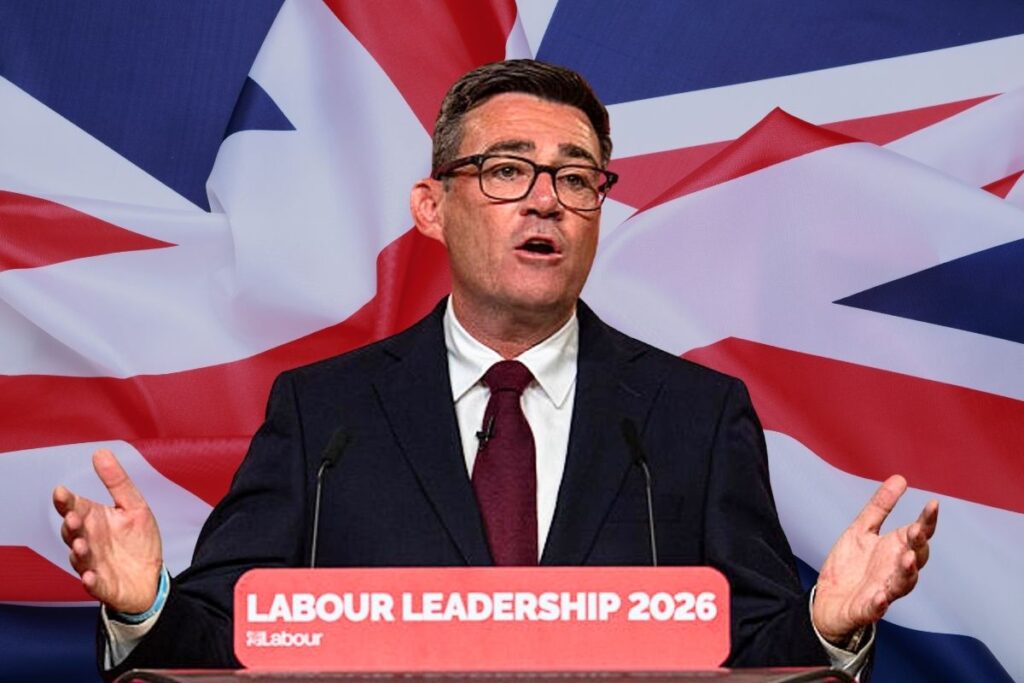




Britain has a new Prime Minister, and his path to Number 10 Downing Street is one of the more unusual political comebacks in recent UK history. Andy Burnham, the former Mayor of Greater Manchester, was sworn in as Prime Minister on Monday, July 20, 2026, following the resignation of Keir Starmer. His rise from regional mayor to national leader in a matter of weeks has made him a defining figure in what has become a decade of remarkable instability at the top of British politics.
This article breaks down who Andy Burnham is, how he got to Downing Street, and what his premiership is expected to look like.
Table of Contents
Burnham, 56, was born in a suburb of Liverpool to parents who worked as a telephone engineer and a receptionist. He was raised in a village roughly halfway between Liverpool and Manchester, a working-class upbringing that has shaped much of his political identity around England’s north-south divide.
He studied at Cambridge before beginning his career in politics and media. Burnham was first elected to Parliament at age 31, representing a northern constituency for the Labour Party. His profile rose considerably when he served as Secretary of State for Culture, Media and Sport under Prime Minister Gordon Brown, and he also held ministerial roles under Tony Blair.
One especially significant moment in his early political career came in 2009, when he was sent to Liverpool to speak on the anniversary of the Hillsborough disaster — the 1989 tragedy in which nearly 100 football fans were crushed to death in an overcrowded stadium, the deadliest sporting accident in British history. Burnham was initially heckled by the crowd, but he went on to become one of the most consistent political voices supporting the victims’ families in their long fight for justice, a cause closely associated with his public identity ever since.
In 2017, Burnham left Westminster to become the Mayor of Greater Manchester, a role he held for close to a decade. During this period, he built a reputation as an outspoken advocate for the north of England, frequently clashing with Westminster over funding, devolution, and regional inequality. This positioning earned him the nickname “King of the North,” a label that stuck as speculation grew over the years about a potential return to national politics.
Burnham’s return to Parliament was engineered through a by-election in the Makerfield constituency, triggered after his ally Josh Simons resigned his seat. It marked the first time in decades that a by-election had been deliberately created to give a political figure outside Parliament a route back in. Burnham was certified as Labour’s candidate after the party’s National Executive Committee approved his candidacy, having previously blocked him from standing in an earlier by-election.
Winning the Makerfield seat cleared the way for Burnham to challenge for the Labour leadership. Keir Starmer, who had been under mounting pressure amid poor polling and internal party tension, announced his resignation shortly afterward. Burnham then secured backing from more than 85% of Labour MPs, making his path to the leadership uncontestable, since any rival would have needed the support of at least 20% of the parliamentary party to mount a challenge.
He was officially confirmed as Labour leader in mid-July 2026 and became Prime Minister on July 20, 2026, after traveling to Buckingham Palace following Starmer’s formal resignation.
In his first remarks as Labour leader and incoming Prime Minister, Andy Burnham pledged to restore hope to the country and challenge what he described as a political culture and economic model that isn’t working well enough for ordinary people. His early policy signals include:
He inherits an economy that has struggled with sluggish growth since the pandemic, though it has recently outperformed both the Eurozone and other G7 economies. Burnham will also need to navigate foreign policy challenges, including a potentially tense relationship with the Trump administration in Washington, with whom he has previously been critical, particularly around technology policy such as Labour’s plan to restrict social media access for under-16s.
Burnham’s ascension makes him the seventh person to hold the office of Prime Minister in just ten years, a reflection of the sustained volatility in British politics since the mid-2010s. His rapid rise — returning to Parliament only weeks before becoming party leader and head of government — is virtually unprecedented in modern UK political history and will be closely watched both domestically and internationally as a test of whether his regional popularity can translate into stable national leadership.
1. Who is Andy Burnham?
Andy Burnham is a British Labour Party politician who became the UK’s Prime Minister on July 20, 2026. He previously served as Mayor of Greater Manchester for nearly a decade and held cabinet positions under former Prime Ministers Tony Blair and Gordon Brown.
2. How did Andy Burnham become Prime Minister?
Burnham won a by-election to return to Parliament, then secured the backing of more than 85% of Labour MPs to become Labour Party leader following Keir Starmer’s resignation. As leader of the governing party, he was appointed Prime Minister after Starmer formally resigned to the King.
3. What happened to Keir Starmer?
Keir Starmer resigned as Prime Minister and Labour leader in mid-2026 following sustained pressure over the government’s performance and internal party tensions. Burnham succeeded him as both party leader and Prime Minister.
4. What is Andy Burnham’s nickname and why?
Burnham is often called the “King of the North,” a nickname earned during his tenure as Mayor of Greater Manchester, where he was known for championing northern England’s interests against Westminster.
5. What are Andy Burnham’s key policy priorities as Prime Minister?
His early stated priorities include easing the cost-of-living crisis, devolving more political power away from Westminster, and scrapping the previous government’s digital ID scheme.

Sign up to receive our email, delivering the latest stories straight to your inbox.